
Last updated October 30, 2026
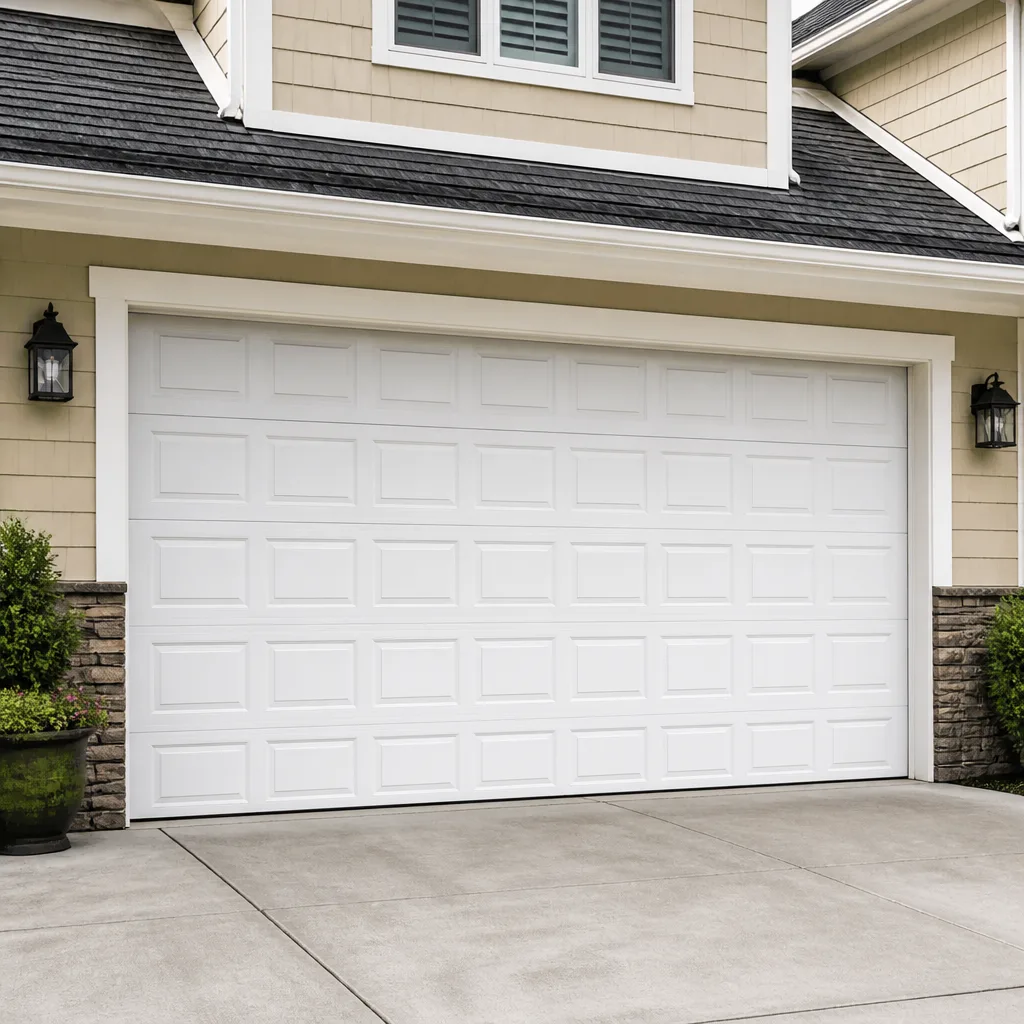 Raised-panel steel
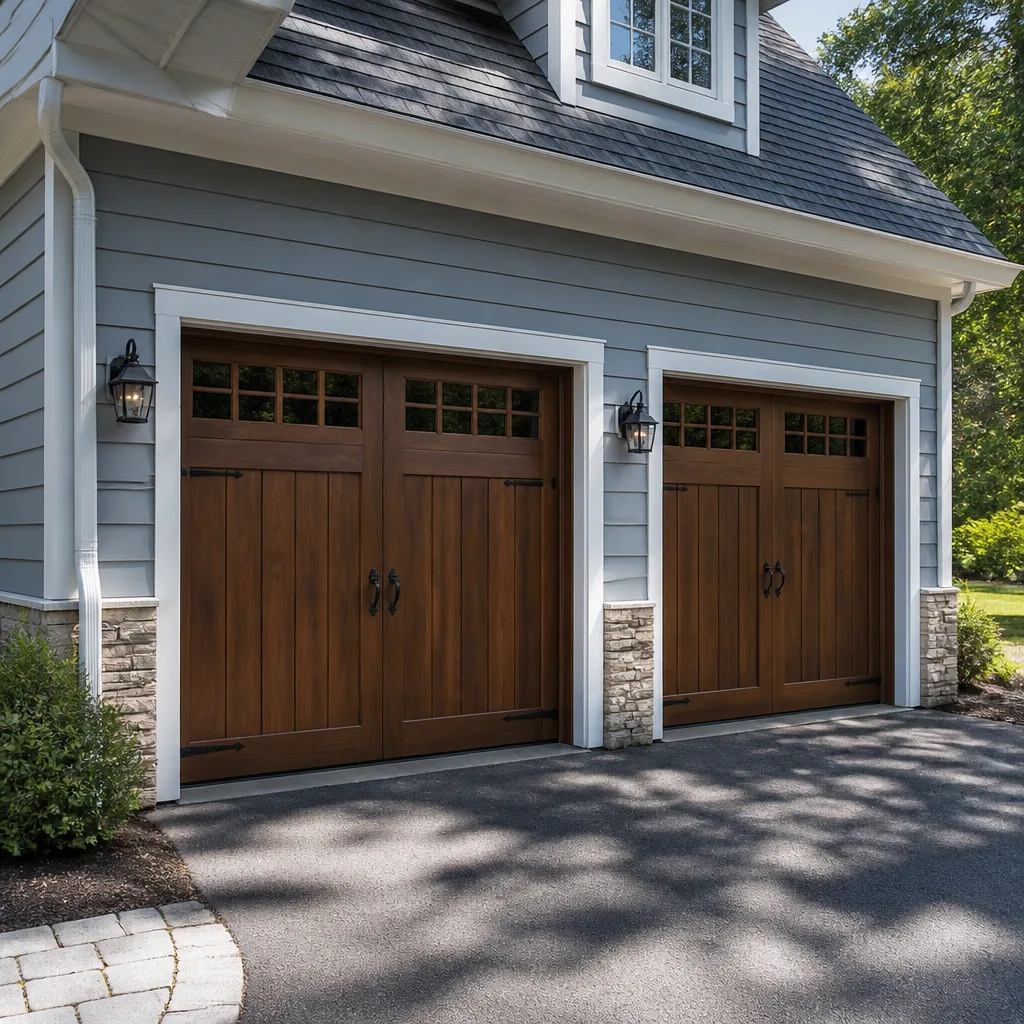 Carriage house
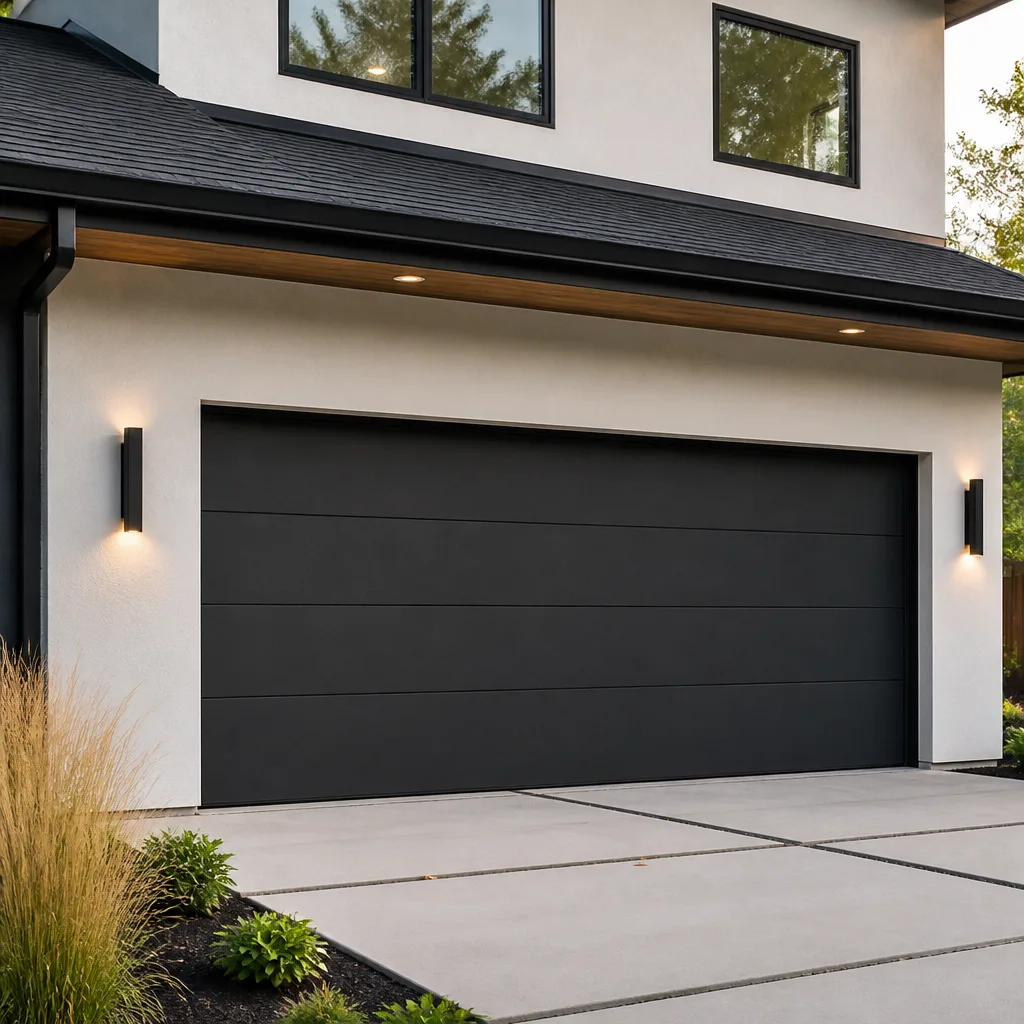 Modern flush
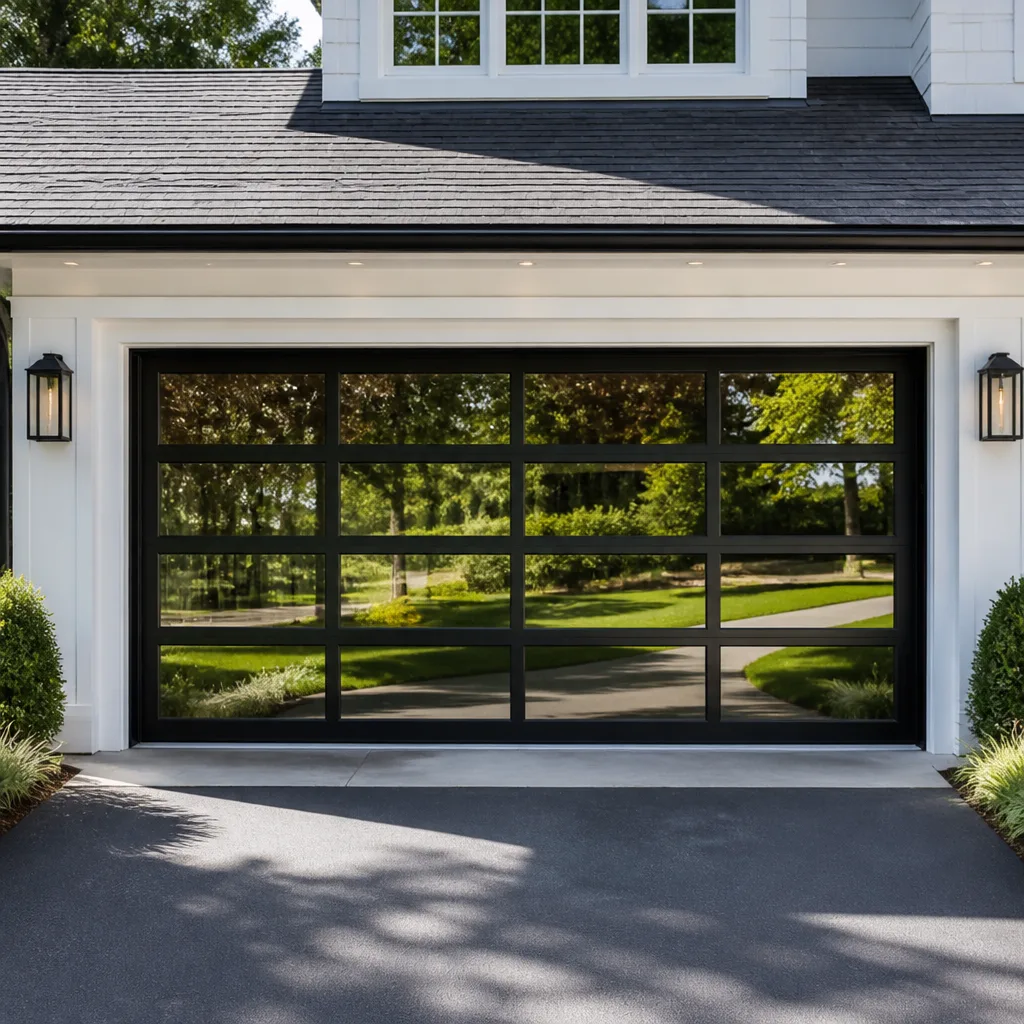 Full-view glass
 LiftMaster openers
 Chamberlain openers
Full 25-point door and opener safety check with every visit - springs, cables, rollers, tracks, and your LiftMaster or Chamberlain opener included
You get a price before we start. It does not change when the truck arrives.
Get your free estimateThe Complete Garage Door Repair Guide for Riverside Homeowners
Riverside’s summer heat doesn’t just test your air conditioner. It tests your garage door. When temperatures climb past 110°F, the metal in your tracks expands, nylon rollers soften, and torsion springs lose a fraction of their tension. What happens next is predictable: a door that sticks halfway up, groans louder than it did in April, or refuses to open at all. This guide explains what’s actually happening inside your system, what it costs to fix in Riverside specifically, and how to avoid paying for repairs you don’t need. We’ll cover the climate factors no national guide mentions, the three repairs Riverside homeowners overpay for most, and how to document your door’s symptoms before you ever pick up the phone.
Styles & brands we work with
Quick Answer
Garage door repair in Riverside typically costs between $125 and $350 depending on the component, with spring replacement at the higher end and minor adjustments at the lower end. Most repairs take under two hours, but you should expect a trip fee of $45 to $75 just to get a technician to your door. The single most important thing you can do before calling anyone is document exactly what your door is doing: the sound it makes, the point where it hesitates, and whether the problem happens every time or only in heat.
Table of Contents
- How Riverside’s Climate Affects Your Garage Door Differently
- The Anatomy of a Riverside Garage Door System
- What You Can Safely Adjust Yourself
- What Requires a Professional, and Why
- What a Legitimate Repair Invoice Should Itemize
- The Three Repairs Riverside Homeowners Overpay For
- How to Document Symptoms Before Calling a Tech
- Common Mistakes to Avoid
- When to Call a Professional
- Frequently Asked Questions
- The Bottom Line
How Riverside’s Climate Affects Your Garage Door Differently
Most garage door guides are written for a generic American suburb with four seasons and mild summers. Riverside is not that place. The Inland Empire gets 90+ days of 90°F heat each year, and garage interiors regularly exceed 120°F because they’re uninsulated boxes with dark roofs. That heat does specific, predictable things to each component of your door system.
Steel tracks expand when hot. A track that was perfectly aligned at 70°F can shift by a few millimeters at 110°F, and that’s enough to make rollers bind. Homeowners in Mission Grove and Canyon Crest report the same seasonal pattern: doors work fine all winter, then start sticking in June. They assume something broke. Usually, nothing broke. The metal just moved.
Torsion springs lose tension faster in heat. Spring steel fatigues more quickly when it cycles through wide temperature swings, and Riverside’s summer days (105°F) followed by cool desert nights (55°F) create exactly that stress pattern. We regularly see springs fail in July and August that were installed in winter, and the heat is a contributing factor.
The Santa Ana winds add another layer. They blow fine dust and sand into garage door tracks, coating the rollers with grit that accelerates wear on both the roller bearings and the track itself. If you live in Alessandro Heights or La Sierra, where the winds hit hardest, you’ll want to wipe your tracks down more often than someone in a coastal city would.
And unlike coastal California, Riverside does get occasional winter frost. When moisture settles on your door’s weatherstripping and freezes, the strip can crack when you open the door in the morning. Those cracks then let in dust, pests, and heat, which means your garage becomes an even more brutal environment for your door.
The Anatomy of a Riverside Garage Door System
Before you can diagnose anything, you need to know what you’re looking at. A residential garage door in Riverside has seven main components, and each one fails in its own way.
The panels are what you see from the street. On most Riverside homes they’re steel or aluminum, segmented, and hinged so the door can follow the curve of the track. Sun exposure on west-facing doors fades and sometimes warps panels over years, especially on Wood Streets or Magnolia Center homes built before modern insulation standards.
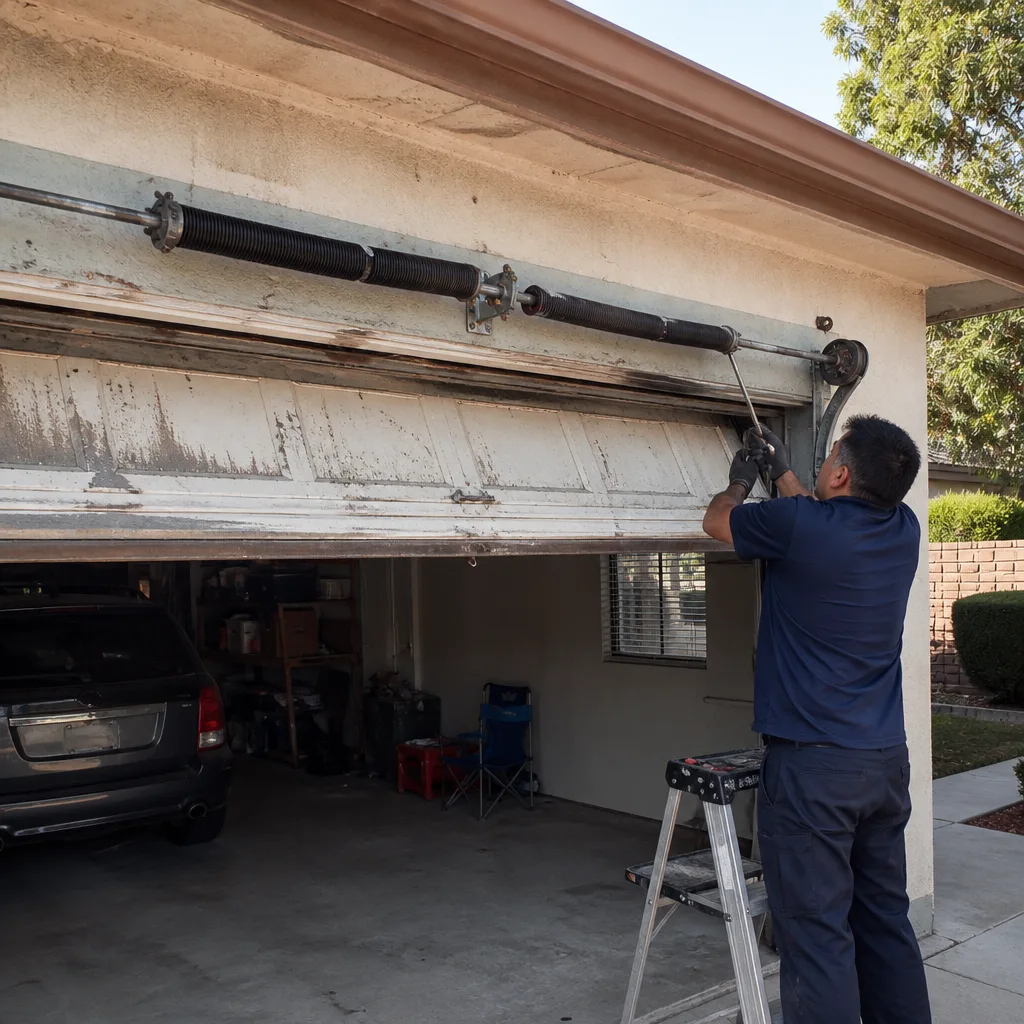
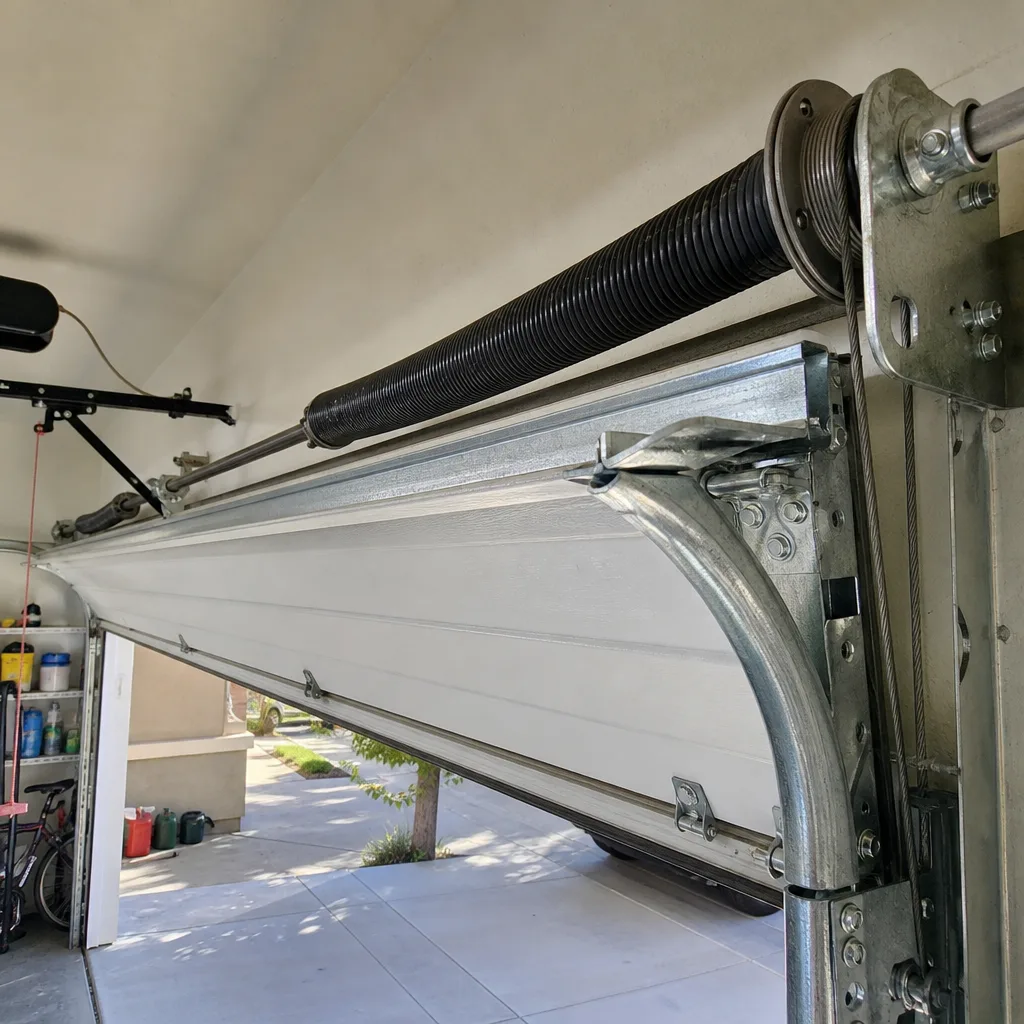
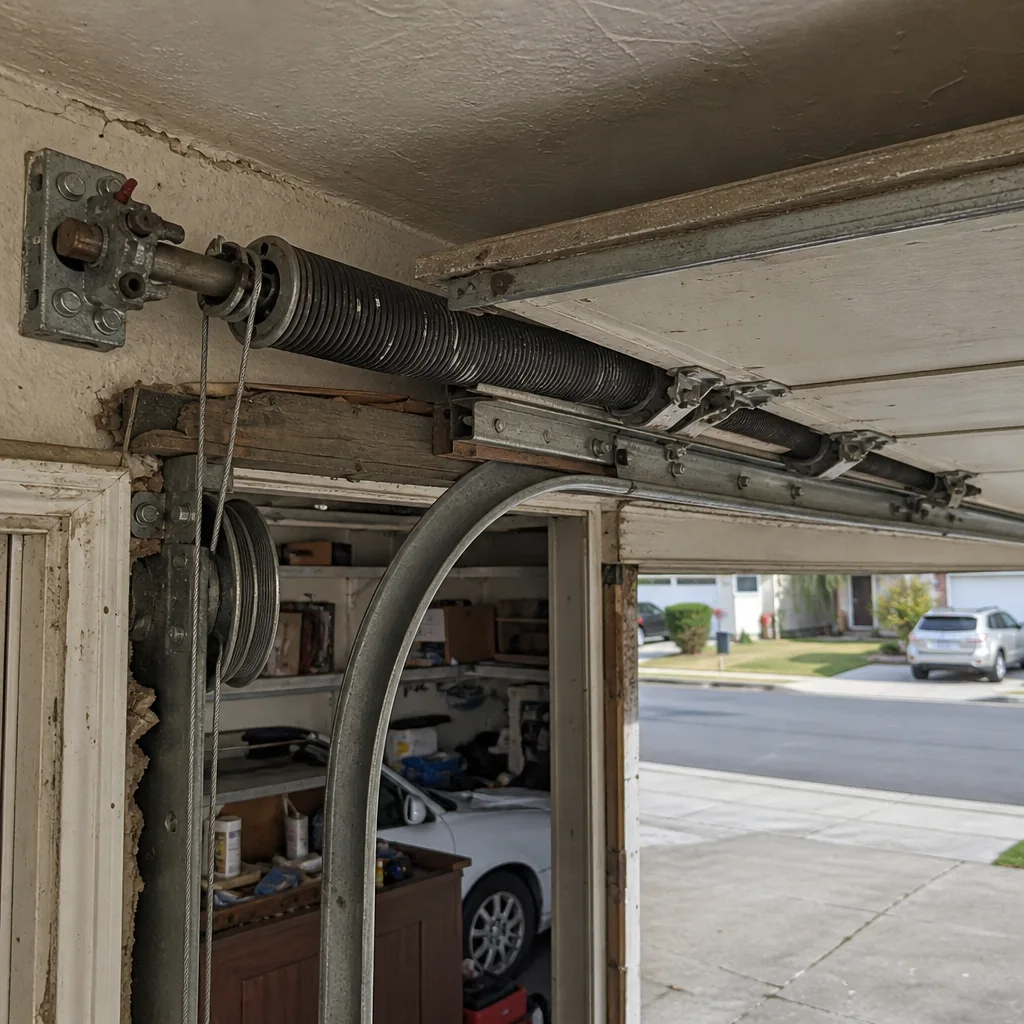
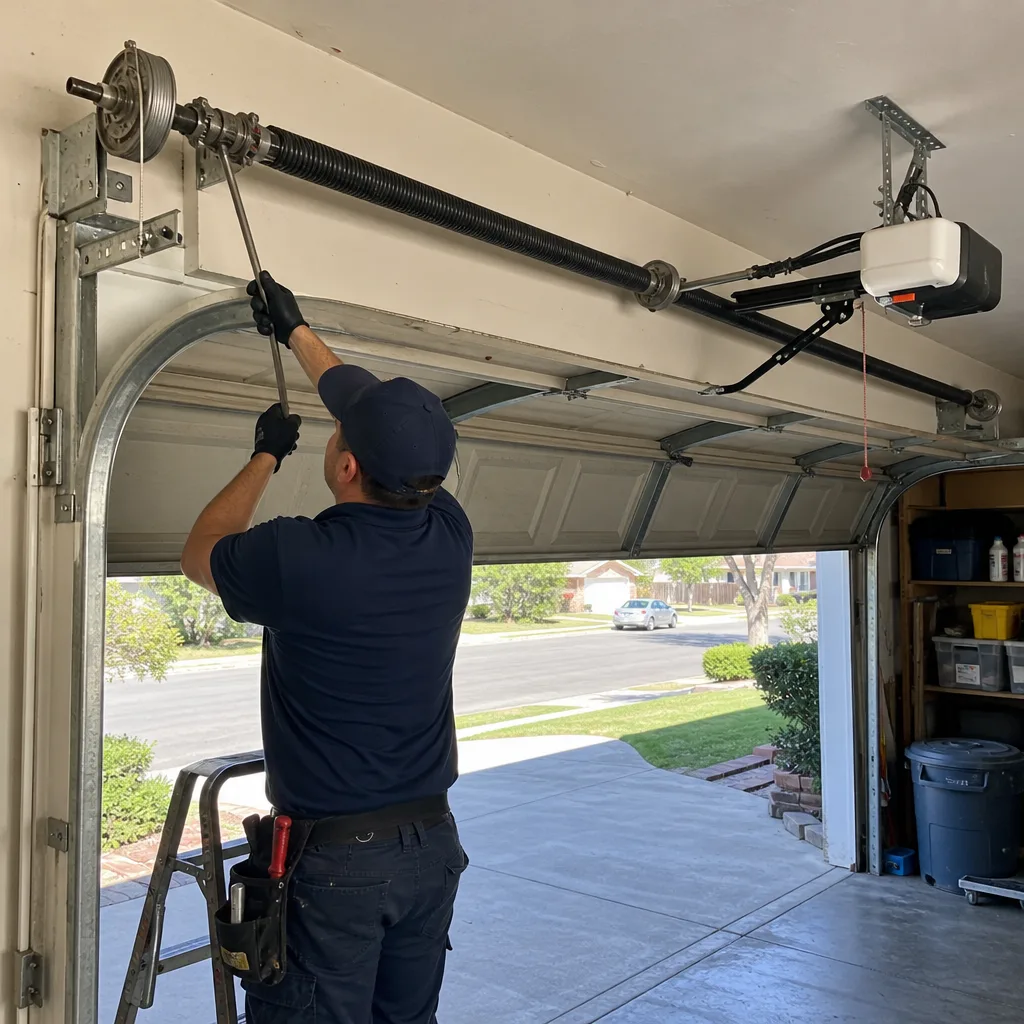
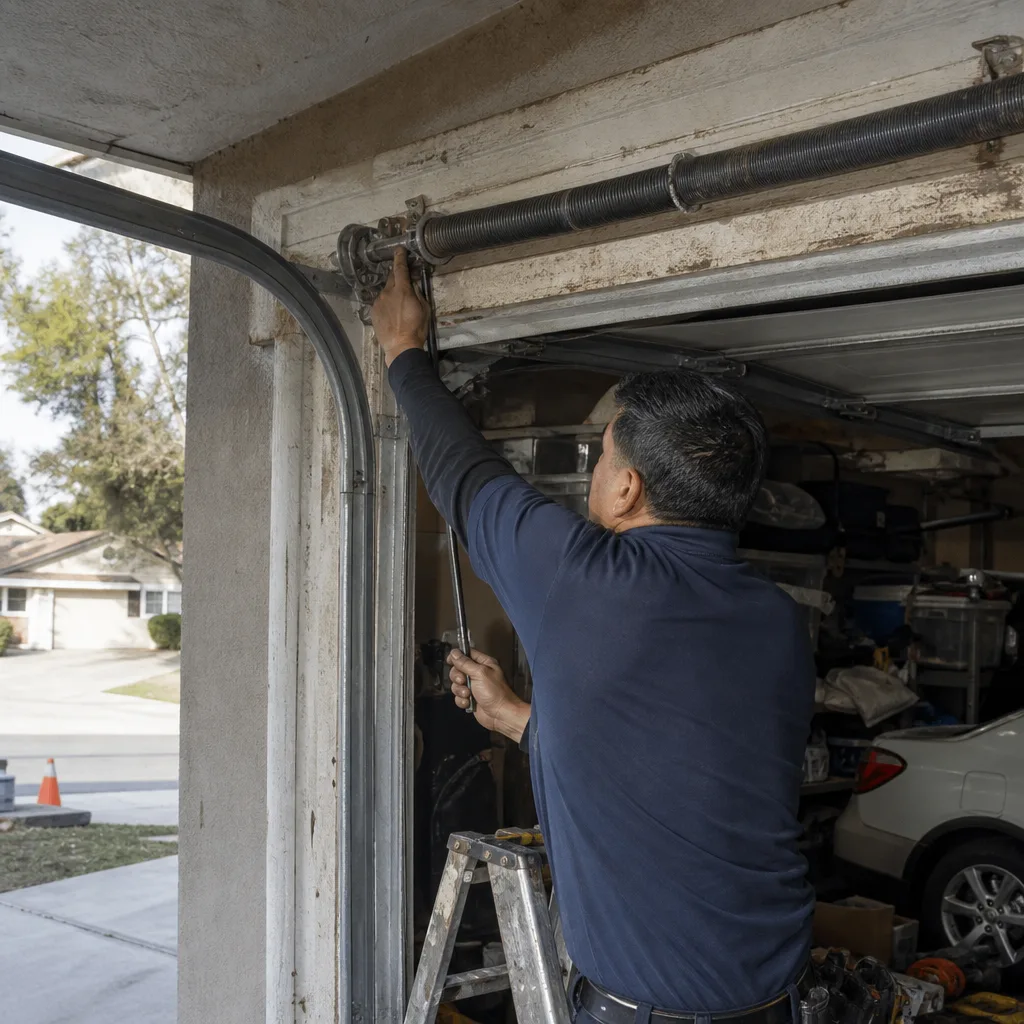
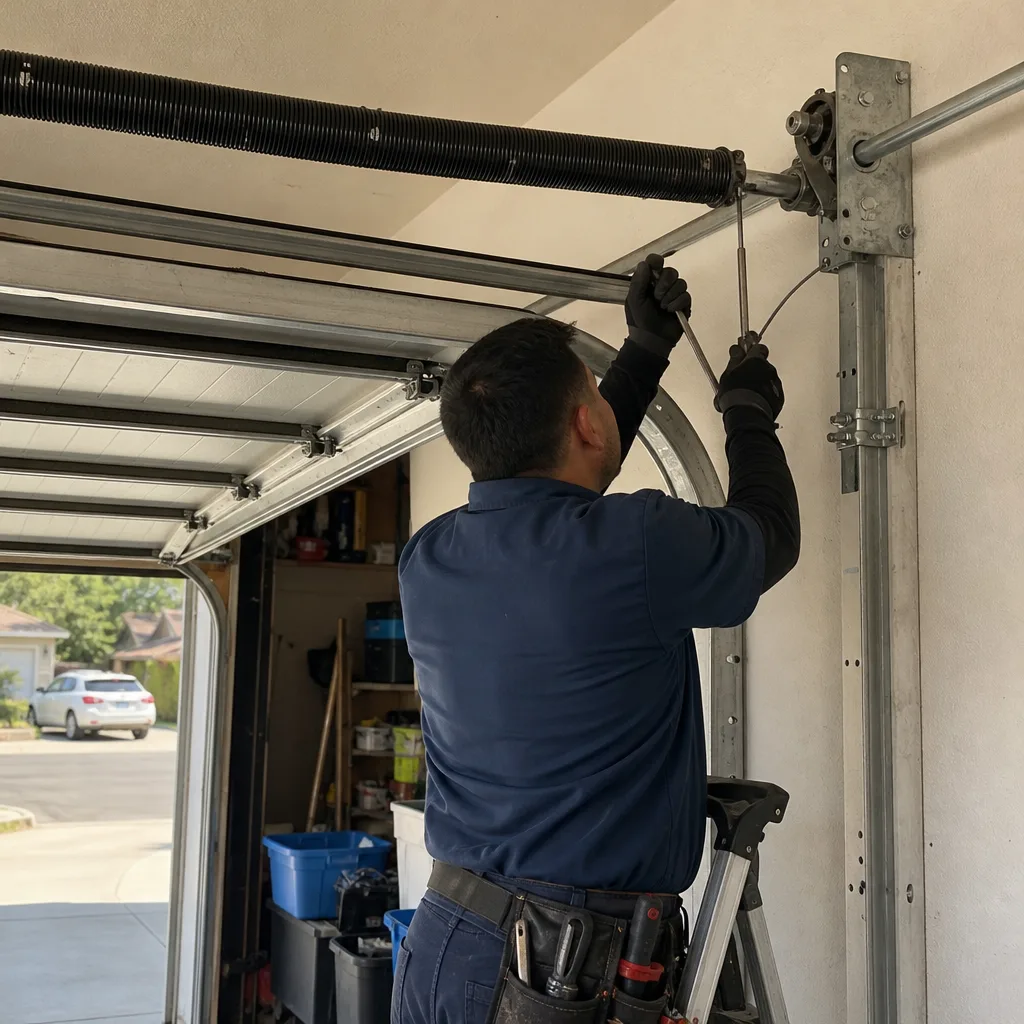
The torsion spring sits above the door, mounted on a metal bar. It stores the tension that counterbalances the weight of the door, and it’s under extreme load at all times. When it breaks, it sounds like a gunshot, and your door becomes dead weight. This is the single most dangerous component on the system, and it requires a garage door repair in Riverside professional to replace.
The extension springs run along the horizontal tracks on lighter or older doors, particularly on homes built before 1990 in neighborhoods like Arlington and Ramona. They stretch and contract instead of winding, and when one snaps, it can send a piece of metal flying across the garage.
The opener is the motor unit hanging from the ceiling. It’s either chain-driven, belt-driven, or screw-driven, and it does the lifting only when the springs are doing their job. If your opener is straining, the problem is almost never the motor. It’s the door.
The cables run along both sides of the door, connecting the bottom brackets to the spring system. They’re galvanized steel, but in Riverside’s dust they accumulate grit that acts like sandpaper every time you cycle the door. Cable replacement is one of the most common repairs we perform.
The rollers are the wheels that carry the door along the track. Nylon rollers are standard now and are quieter than steel, but nylon degrades faster under Riverside’s heat. A roller can look fine from the side and still be flat-spotted.
The sensors sit near the floor on both sides of the opening. They project an invisible beam, and if anything crosses it while the door is closing, the door stops and reverses. Direct sun, especially low winter sun in Riverside, can blind a sensor and make the door behave erratically.
What You Can Safely Adjust Yourself
There’s a small but real category of garage door problems that a careful Riverside homeowner can handle without any specialized tools. Let’s be clear about the boundary: if it involves a spring under tension, it’s not on this list.
- Realigning blocked safety sensors. If your door closes partway and then reverses, check the sensors first. Dust, spider webs, and yard debris can block the beam. And Riverside’s low-angle winter sun can hit the receiver sensor directly. Bend the mounting bracket slightly, or cut a section of cardboard tube and slide it over the sensor as a shade. This is a two-minute, zero-risk fix.
- Lubricating hinges and rollers. A garage door that squeaks in Riverside is usually dry, not broken. Use a silicone-based lubricant or white lithium grease on all hinge pins and the roller bearing area twice a year. Do not use WD-40; it’s a solvent, not a lubricant, and it strips what little lube is already there.
- Tightening loose hardware. Every cycle of your door vibrates the nuts and bolts that hold the track brackets to the wall. Check them with a socket wrench every few months, especially on the track brackets and the hinges. Loose hardware is the number one cause of track misalignment that isn’t climate-related.
- Testing the balance. Disconnect the opener by pulling the red release cord, then lift the door manually to waist height and let go. It should stay put. If it falls, your springs are losing tension. You can test this yourself; you just shouldn’t fix it yourself.
- Clearing debris from the tracks. In Riverside, your tracks collect dust, brittle leaves from citrus trees, and the occasional lizard. Wipe them out with a dry cloth every few months and check for anything stuck in the bottom of the vertical track.
What Requires a Professional, and Why
The hard line is torsion springs. No exceptions. A torsion spring is wound under 200 to 300 pounds of torque, and if it slips while you’re working on it, the bar it’s mounted on becomes a blunt instrument moving at high speed. That’s not a scare tactic. That’s the reason every legitimate technician in Riverside will tell you the same thing: torsion spring replacement is not a DIY job, not even for a capable homeowner.
Here’s what else needs a professional, with the reason attached.
Cable replacement. The cables connect the bottom of the door to the spring system, which means you can’t touch them without either unloading the spring or dealing with the full weight of the door. One slip and a 150-pound door comes down on you.
Track repair or replacement. If a track has actually bent, not just shifted, it needs to be ordered and installed to match your door’s specific dimensions. Bending it back by hand never works, and it usually makes the problem worse by creating a new misalignment further down the line.
Opener motor replacement. The opener is an electrical appliance, and like any motor unit it can short, burn out, or fail in ways you can’t see from outside. If the motor is humming and the door isn’t moving, the drive gear is probably stripped, and that’s an internal repair. We repair garage door openers in Riverside as a core service, and we’d tell you if a replacement made more sense. Check garage door opener repair in Riverside for details.
Full panel replacement. If a car backed into the door, or a panel has rusted through, you’re not repairing that panel. You’re replacing it, and panels are specific to the door model. A broken panel on an Amarr or Wayne Dalton door means matching the color, texture, and insulation rating, which is something a tech with brand experience should handle.
What a Legitimate Repair Invoice Should Itemize
This is where Riverside homeowners get taken advantage of, and it’s the section of this guide we care most about. A legitimate invoice has three lines. A padded one has more, and the extras are always vague.
A legitimate invoice looks like this:
- Trip fee: $45 to $75. This covers the tech’s time to drive to you, and it’s standard in Riverside and throughout the Inland Empire. Some companies waive it if you approve the repair, but you should expect to pay it.
- Labor: $65 to $95 per hour, and most repairs are one to two hours of actual work. You should see a labor line with an hourly rate or a flat-rate labor charge.
- Parts: The actual spring, roller, cable, or sensor that was replaced. The part should be named. Not “door hardware” but “torsion spring, .250 wire, 31-inch” or “nylon roller, 3-inch, 3-inch stem.”
A padded invoice looks like this:
- A line for “miscellaneous supplies” or “shop fees” that no one mentioned by phone.
- A labor charge of 3+ hours for a one-spring replacement that takes 75 minutes.
- A second part you never saw: “bushing,” “bearing plate,” “reinforcement clip.” Some of these are real, and occasionally needed. Too often in Riverside, they’re on the invoice because the company needs a bigger number.
- A “tune-up package” added without your consent. If you didn’t ask for it and the tech didn’t tell you the price before starting it, you shouldn’t be paying for it.
The fix for all of this is one sentence, said before the work starts: “Show me what’s broken before you touch it.” A legitimate company has no problem with that. At Honest Garage Door Service, the diagnosis comes before the quote. Always. That’s the whole point of the name, and it’s why we recommend you ask any company in Riverside the same question.
The Three Repairs Riverside Homeowners Overpay For
Over our years working on doors across Riverside, from Orangecrest to the University neighborhood, three repairs stand out as the ones where homeowners most consistently pay more than the work is worth.
1. Spring replacement with a “must replace both” upsell. Here’s the nuance. On a door with two springs, replacing both is often the right call, because when one breaks, the other is close behind. The logic is sound. The overpayment happens when the quote is built on a single high-priced spring and then doubled. A standard torsion spring in Riverside costs $40 to $85 as a part. Two should be $80 to $170. Labor is what it is. If your quote for a two-spring replacement is over $450, you’re paying too much, and you should get a second number.
2. Cable replacement priced as an emergency, even when it isn’t. A frayed cable is time-sensitive. A broken cable means the door can’t operate safely and could fall. That’s not the overpayment. The overpayment is when a company quotes you $350 for a cable replacement that takes 45 minutes and uses $25 in parts. Riverside sees a lot of this because the heat and dust genuinely do wear cables faster here than elsewhere, so the work is common. That means the honest pricing should be standard, not inflated.
3. The “full tune-up” sold after a one-part repair. You call because a roller broke. The tech fixes it in 20 minutes, then says your door “really needs a full tune-up” for $180. Sometimes that’s true. A lot of the time, it’s a script. A tune-up is a real thing: lubrication, bolt-tightening, balance check, sensor alignment. It should cost $75 to $120. If your door is working fine after the repair and the tech can’t point to something specific that’s wrong, a tune-up is a recommendation, not a necessity.
How to Document Symptoms Before Calling a Tech
This is the single most effective thing you can do to protect yourself from a bad repair experience. Write down what your door is doing, in specific language, before you call. Not because the tech needs a novel. Because when you describe the problem accurately, the tech who shows up already has a working theory, and the company can quote you a range over the phone instead of giving you a blank stare and then a blank check.
- Describe the exact failure moment. Does the door open halfway and stop? Does it reverse on the way down? Does it not open at all, but you hear the motor running? “It opens a foot and then stops, and it makes a grinding sound right before it stops” tells us more than “it’s broken.”
- Note when it happens. Every time, or only in the afternoon? Only in the heat? Only after the door has been closed overnight? Riverside’s temperature swings matter here. A door that only sticks at 3pm in July is a heat expansion problem, not a broken part.
- Record the sound. Your phone has a voice recorder. Use it. A bang, a pop, a squeal, a rumble, a click. Each one points to a different component. When you play it for us over the phone or when we’re standing in your driveway, we know a lot more.
- Check both sides. Look at the cables on the left and right. Are both attached at the bottom bracket? Is one hanging loose? Look at the rollers while the door moves. Can you see one not spinning?
- Try the manual release. Pull the red cord, lift the door by hand. Does it move smoothly and stay where you put it? If it’s heavy and won’t stay up, your springs are the problem. If it lifts easily and stays, your opener is the problem. That one test eliminates half the possible failures, and you can do it before you ever call us.
When you’ve done these five things, you can call a company and say something useful. And the company that quotes you a price over the phone based on that description? That’s probably an honest one.
Common Mistakes to Avoid
- Lubricating the track itself. You lubricate rollers and hinges. Not the track. Lubricant on the track collects Riverside’s dust and sand, turning the track into a grinding surface. Keep the track dry and clean.
- Trying to adjust the spring tension with a screwdriver. Torsion springs are wound and unwound with specific winding bars, not whatever tool is in your drawer. One slip with the wrong tool can send the winding cone flying, with your hand attached to it. Do not touch these.
- Assuming the opener is the problem when the door is heavy. The opener is not designed to lift a heavy door. If your door is hard to lift by hand, the springs have failed or are failing, and a new opener won’t fix it. You’ll just burn out the new opener in a month.
- Skipping the trip fee question. Ask by phone: “Is there a trip fee, and is it credited toward the repair?” A company that won’t answer that question directly is a company that will charge you more than the answer would have been.
- Replacing a door when only a panel is damaged. If one panel is cracked from an impact, you can usually replace that panel. Unless the door is more than 15 years old, in which case panel matching gets hard and full replacement may honestly be the better path. Get both prices before you decide, and don’t let a company rush you toward the more expensive option.
- Buying a new door from the first estimate you get. Prices in Riverside for garage door installation in Riverside vary by thousands depending on insulation, material, and hardware. Get at least two quotes for the same door model so you’re comparing apples to apples.
- Ignoring a noise for six months. That grinding sound when you open the door in the morning? It has a cause, and the cause doesn’t go away. In Riverside’s heat, a dry roller becomes a flat-spotted roller, which becomes a damaged track, which becomes an $800 repair instead of a $35 part.
When to Call a Professional
If your torsion spring is broken, call. If your cables are frayed or hanging, call. If your door came down on something, bent a track, and now jerks when it moves, call. If your opener motor is making a humming sound with no movement, call. These are the scenarios where continuing to run the door makes the problem actively worse, and in the case of cables and springs, creates a safety hazard for anyone standing near the door. We’ve also seen cases where a heating element in an older opener near Riverside’s hottest attic-adjacent garage spaces degrades faster; if your opener smells hot or trips a breaker, that’s not something to reset and ignore.
Honest Garage Door Service offers free estimates in Riverside. The name is the promise: we tell you what’s wrong before we tell you what it costs, and the number we quote is the number you pay. Call (833) 620-3811 to schedule.
Frequently Asked Questions
Most our Garage Door Repair services in Riverside run between $125 and $350, including parts and labor. Spring replacement is at the higher end, roller or sensor replacement at the lower end. You’ll typically pay a $45 to $75 trip fee, which some companies credit toward the repair if you approve the work. Call (833) 620-3811 for a free estimate on your specific issue.
Yes, most garage door repairs can be completed the same day you call, especially spring, cable, and sensor issues. Our Riverside service area means a technician can usually reach you within a few hours, and the repair itself is typically under two hours. That only applies to repairs, not installations, which are scheduled and measured.
Not from a legitimate company. The price quoted over the phone should match the price at your door, unless the technician finds an additional, separately-communicated problem that you approve before any work starts. At Honest Garage Door Service, the price is quoted and agreed before any work begins, and that agreement is binding.
For the most common Riverside repairs, yes. Springs, rollers, cables, sensors, hinges, and most opener components are stocked on our trucks at all times. That’s why most repairs can be completed same-day. If your door needs a model-specific part, you’ll know that before we schedule the repair, not after we’ve arrived.
Standard torsion springs are rated for about 10,000 cycles, which is roughly 7 to 10 years for most Riverside households. But the Inland Empire’s heat and the wide temperature swings between day and night can shorten that lifespan, especially on west-facing garages. If your springs are more than 8 years old and you’re hearing a creak when the door moves, they’re telling you something.
A repair fixes a specific failed component on your current door and typically costs $125 to $450. A replacement means a brand-new door, measured, ordered, and installed, typically running $1,400 to $3,800 in Riverside depending on material and insulation. The honest answer is usually a repair, unless your current door is more than 15 years old, has multiple failed panels, or has rusted through the bottom section. A technician should tell you both options and their costs, as covered in DIY vs Professional Garage Door: The Riverside Homeowner’s Decision Guide, not steer you to the more expensive one by default.
The Bottom Line
Garage door repair in Riverside isn’t complicated, but it’s full of opportunities for overpayment. The climate here is harder on doors than coastal locations are, which means repairs are more common than in, say, San Diego or Long Beach. That frequency should produce better, more predictable pricing, not the opposite. The way to protect yourself is simple, and it’s the same advice whether you hire us or someone else: document the symptoms before you call, ask for the diagnosis before the price, and never approve work you don’t understand. The mechanics of a garage door are knowable. So is the price of fixing one. Any company that acts otherwise is selling something other than repair.
Written by the team at Honest Garage Door Service, serving Riverside since 2015. Explore more guides & resources.
See the difference
 Before
 After
 Before
 After
 Before
 After